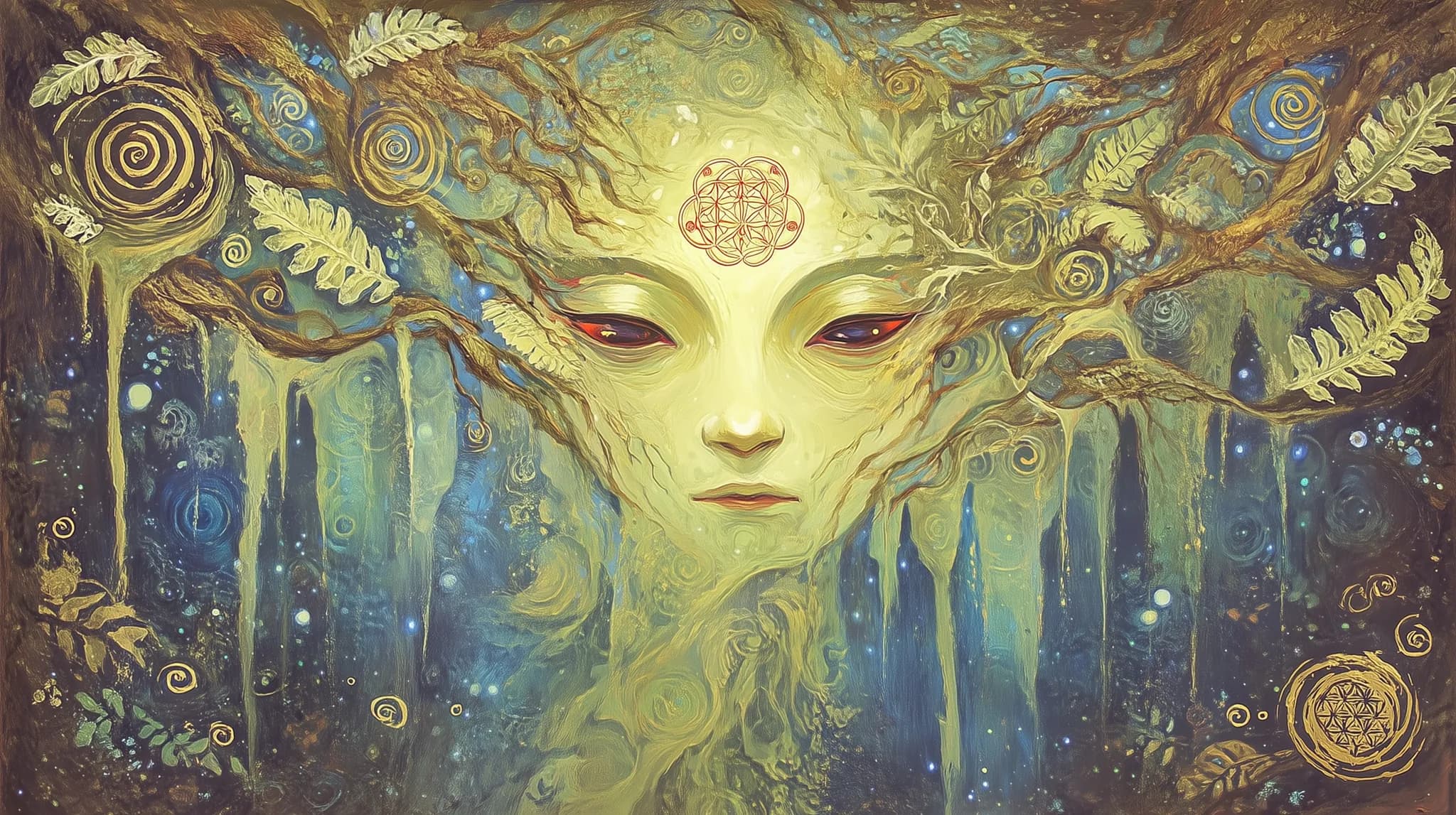
No living tradition of plant medicine has ever separated the plant from its moment. Time is part of the plant. The plant is part of time.
You know what day it is. Probably not what phase the moon is in. Probably not how many minutes of daylight remain. Probably not what plant is flowering three kilometres from your home, or which one is pulling back under the earth to wait out winter.
This ignorance is recent. For most humans who lived before us — everywhere, on every continent, in every language — time was not a grid of boxes to fill. It was a wheel. It turned. You knew where you stood on the wheel because you looked. Leaves rising, light descending, sap circling, birds departing, berries ripening, the first frost pinching, the first thaw surprising.
No living tradition of plant medicine has ever separated the plant from its moment. June chamomile does not accompany the same things as September chamomile. Root harvested in autumn does not carry the same qualities as root harvested in spring. Winter ceremonial cacao calls something different from summer cacao. Time is part of the plant. The plant is part of time. To sever them is to kill the medicine.
This page is about returning the wheel to our lives. Not as neo-Celtic reconstruction or wiccan appropriation — INFUSE is neither of those things. But as a patient return to the real: there are eight thresholds in the year that humans have recognised almost everywhere, and each one calls for a gesture, a plant, a pause.
I. Cyclical time against linear time
We have to begin by naming what happened.
In industrial societies, time was redrawn. Lewis Mumford documented it in Technics and Civilization (Harcourt, 1934): the invention of the mechanical clock in the fourteenth century, in Benedictine monasteries, then its spread through merchant cities, produced a silent revolution. Time ceased to be a quality — the hour of birdsong, the hour when sunlight touches the west wall, the hour when hunger arrives — and became a measurable, divisible, billable quantity.
This transformation carries a cost we are only beginning to measure. E.P. Thompson, in his essay Time, Work-Discipline, and Industrial Capitalism (Past & Present, 1967), shows how industrial discipline replaced the natural rhythm of tasks (you sew when sewing is needed, you harvest when rain permits) with an abstract clock that makes everything convertible to wages. The result: we live in a time that knows nothing of seasons, plants, bodies, lunar cycles. A time uprooted.
This time has a consequence for medicine. Modern pharmacology normalised the idea that a molecule does the same thing in January and July, at 6am or 10pm, at age 20 or 60. This idea is convenient for clinical trials. It is false for most plants. Chronobiology rediscovered it in the 1980s (Halberg, Reinberg): circadian, infradian, and seasonal rhythms profoundly alter the body's response to substances. The old traditions knew this without a laboratory. They prepared the root at the right moment. They gave the infusion at the right hour. They harvested under the right moon.
Tyson Yunkaporta states it from Aboriginal thought in Sand Talk (Text Publishing, 2019):
Time is not a straight line. It is a series of nested cycles, and you live inside all of them at once.
Returning the wheel to our lives is not folklore. It is an epistemological act: we accept that the real has multiple rhythms, and that our medicine — plant, nutritional, relational — gains from aligning with those rhythms rather than ignoring them.
II. The eight thresholds
Four thresholds are astronomical. They are not cultural inventions — they are facts of the solar system. Two solstices (the longest night, the longest day) and two equinoxes (the two annual moments when day and night are equal). These four points have been marked by nearly every civilisation that left a trace — Stonehenge, Newgrange, Chichén Itzá, the pyramids of Giza, the Maya calendar, Sumerian temples.
Four other thresholds are intercalary. They fall midway between solstices and equinoxes, and they mark the lived turnings of climate — when spring truly begins to be felt, when summer tips toward heavy heat, when autumn settles in, when winter bites. These four points have names across several traditions: Imbolc, Beltane, Lammas, Samhain in the Celtic tradition; Lichun, Lixia, Liqiu, Lidong in the Chinese solar calendar; and comparable markers in Amazonian, South African, Ayurvedic, and Japanese practice.
INFUSE has no tradition of its own to invoke. We are not going to reconstruct a liturgical calendar we have not received. But we can name the eight thresholds as factual moments — each threshold has a quality of light, temperature, sap, breath, and each calls a precise plant from our catalogue. That is what we offer.
You are not obliged to anything. You can ignore the wheel, live in industrial time, take your plants out of season. It will work. But if you try for one year to align — drinking the threshold plant when the threshold arrives — you will discover something. Not a spectacular transformation. An interior slowing. An attention that returns.
III. The thresholds in detail — northern hemisphere
The sequence follows the western calendar year, beginning at the winter solstice which opens the wheel in most northern cosmologies.
1. Winter solstice — around 21 December
The longest night. The pivot. From this moment, light returns — imperceptibly at first, then a little more each day. Northern peoples have almost all ritualised this moment, from the Scandinavian Yule to the Chinese Dongzhi, through the Hopi Soyaluna and the Roman Sol Invictus.
The energy is that of reversal. Not beginning — beginning is later. This is the instant when what has been descending for six months ceases to descend. The pivot carries a particular quality: dense silence, maximum interiority, fine listening. One does nothing. One honours what has fallen to allow what will return.
Plants aligned in our catalogue: ceremonial cacao (the dense warmth, the heart opening in the cold, the K'iche' transmission that celebrates rebirths), reishi (the Taoist mushroom of immortality, medicine of deep rooting and the immune system at winter's entry), imphepho South African (ancestor incense smoke offering to close the year and cross the threshold — Xhosa use documented in Hirst).
Suggested gesture: the evening before, prepare a warm cacao with lemon balm. On the night of the solstice, turn off the main lights and keep a single candle. Write on paper what you set down. Burn the paper. Drink the cacao in silence. Sleep early. No alarm.
2. Imbolc — around 1 February
Midway between winter solstice and spring equinox. The moment when, beneath still-frozen earth, something stirs. Sap begins to rise in trees. Lambs are born (the word Imbolc comes from a Gaelic word for the returning milk of ewes). The first snowdrops emerge. Light has gained an hour each day since December.
The energy is that of promise. Nothing flowers yet. But something is preparing. This is the moment to plant seeds, inwardly as in the garden.
Plants aligned in our catalogue: damiana (gentle warmth from the south that reawakens the body numbed by winter, Turnera diffusa used by the Maya for sensual awakening), wild poppy Californian (Eschscholzia californica, which helps finish winter without exhaustion, sleeping gently as the nervous system begins to relight), mugwort (Artemisia vulgaris, European prophetic plant that assists late-winter dreams — Hildegard of Bingen writes of it).
Suggested gesture: an infusion of damiana and mugwort, shared with someone close. Write together or alone a promise for the coming season — not a goal, an orientation. Place it on the table by a candle. Re-read it in three months.
3. Spring equinox — around 20 March
The moment when night and day balance at 12 hours each, before day takes over for six months. The moment of dynamic balance — Holi in India, Iranian Nowruz, Germanic Ostara, Chinese Spring Festival, Jewish and Christian Passover.
The energy is that of momentum. Breath returns. Sap is truly rising now. One feels the body wanting to move, emerge, begin again. This is also the moment of greatest vulnerability to transition — Ayurvedic medicine speaks of unbalanced vata at the spring crossing, to be protected with gentle plants.
Plants aligned in our catalogue: bobinsana (Calliandra angustifolia, Amazonian tree that opens the heart and gives courage for the new season, Shipibo dieta plant documented in Beyer), mexican tarragon (Tagetes lucida, Mexica plant that sings transitions, used for dreams and clarity), brahmi (Bacopa monnieri, the Ayurvedic rasayana that regenerates the nervous system after winter and prepares attention for the active season).
Suggested gesture: walk out early on equinox morning, watch the sun rise (at the true local hour, not artificially shifted). Return. Prepare a brahmi-mexican tarragon infusion. Write what you want to do this season — concretely, not philosophically. One project per season.
4. Beltane — around 1 May
Midway between spring equinox and summer solstice. The moment when summer is certain to arrive. Flowers explode. Pollinators work at full capacity. Buds break into leaves. In the Celtic tradition, this is the fire festival (Bel-tene = fire of Bel), the passing of herds between two fires for purification, and fertility celebrated without detour.
The energy is that of sensuality. The body wants to be seen, touched, flowered. The most fragrant plants are at their peak. This is the moment of simple desire, not introspection.
Plants aligned in our catalogue: rose (Rosa centifolia, Rosa damascena, the European archetype of the flowering heart, present throughout Sufi and medieval Christian traditions), pink lotus (Nelumbo nucifera, sacred Hindu and Buddhist flower, padma that opens the upper centres, to drink as a light infusion in May-June), damiana again (in spring she is more in flower, more gentle).
Suggested gesture: gather flowers (from your garden, from an ethical florist, anything that perfumes), prepare a bath or simply place them on the dinner table. Invite one or two close people. Drink a rose and damiana infusion. Dance if you feel like it. Laugh. No plan, no subject.
5. Summer solstice — around 21 June
The longest day. The peak. From this moment, light begins to descend, but heat will continue to build for two more months (the thermal lag). The moment of luminous fullness — Litha in the Germanic tradition, San Juan in Spain, Midsommar in Sweden, the feast of Saint John in France which inherited pre-Christian solsticial fires.
The energy is that of culmination. One is outside. One lives the light. This is the moment when one works hard in the fields (paradox: the festival is also a relief before the coming harvests). The moment of vigils that last all night because the night lasts almost nothing.
Plants aligned in our catalogue: guayusa (Ilex guayusa, plant of the Kichwa people of Amazonia, which supports the pure clear energy of long days, to drink as a morning decoction), mugwort (in June, Artemisia is at its vital peak, traditionally the moment to harvest it, and it is the plant of prophetic dreams in short nights), aparajita (Clitoria ternatea, blue flower of Southeast Asia, dedicated to Vishnu, a visually sumptuous turquoise infusion for full-light rites).
Suggested gesture: take the solstice morning guayusa (slow decoction, as the Kichwa do at dawn). Stay outside as long as possible. Watch the light work. In the evening, take a mugwort infusion before sleep and note the dreams on waking — the European tradition attributes particularly telling dreams to this night.
6. Lammas — around 1 August
Midway between summer solstice and autumn equinox. The beginning of harvest. The first wheat is cut. Heat is still heavy but something has shifted — days are visibly shorter, nights becoming cool again in the south, birds changing their song. Lammas comes from loaf-mass, the mass of bread — that of the first loaf baked from the year's grain.
The energy is that of first fruit. One harvests what was sown in March-April. One takes stock. One gives thanks. The moment of honest evaluation — not to feel guilty, but to adjust what remains of the season.
Plants aligned in our catalogue: ashwagandha (Withania somnifera, Ayurvedic root rasayana, which supports the nervous system at the end of the long active season — whole dried root, not standardised extracts), shatavari (Asparagus racemosus, the plant of “a hundred husbands” that nourishes the feminine at summer's end), ceremonial cacao in a lighter, more ritual preparation than in winter — to celebrate collectively the first harvests.
Suggested gesture: a dinner with close friends around what is growing right now (tomatoes, courgettes, the first figs). Drink an ashwagandha milk infusion before sleep. During the meal, each person names one thing harvested this year — concretely (a book finished, a friendship repaired, a project completed, a plant befriended).
7. Autumn equinox — around 22 September
The moment when night and day balance at 12 hours each, before night takes over for six months. The mirror of the spring equinox — Mabon in the Anglo-Saxon neo-pagan tradition, Chuseok in Korea, Mid-Autumn Festival in China, Sukkot in the Jewish tradition.
The energy is that of recollection. Light is truly falling now. Leaves are changing. The moment to bring in what needs bringing in, outside as within. Chinese medicine associates autumn with the lungs, the immune system, deep breathing, and grief — not pathological grief, the healthy seasonal grief of all that goes to sleep.
Plants aligned in our catalogue: calea zacatechichi (Calea ternifolia, “leaf of God” of the Mazatecs of Oaxaca, plant of lucid dreams, to drink on the equinox evening — ritual use documented in Mayagoitia and Cardes), mugwort (always, for autumn which is its full harvest season in the north), mexican tarragon (which for the Aztecs marked precisely the end of summer and the return of the dead — preparation for Día de los Muertos in November).
Suggested gesture: take time to notice the changing light. Walk somewhere with trees. Gather three leaves to keep on the table. In the evening, prepare a light calea or mugwort infusion. Sleep. Note the dreams in the morning without analysing them — just set them down.
8. Samhain — around 1 November
Midway between autumn equinox and winter solstice. The moment when winter truly begins. Trees have released their leaves. Nights are long, cool, sometimes biting. Traditionally the end of the Celtic year, and the night when the veil between worlds grows thin — Halloween inherited it, as did the Christian All Saints and the Mexican Día de los Muertos.
The energy is that of the open threshold. The moment to honour ancestors, the dead, the departed versions of oneself, projects that did not come through, loves that have gone. No forced sadness. An honoured presence. Prechtel reminds us: grief that is not given a chant becomes depression.
Plants aligned in our catalogue: the ubulawu family (Silene undulata principally, iindlela zimhlophe in Xhosa, the “white paths”, plants of divination and communication with ancestors for the South African Sangoma — use documented in Hirst, to approach with attribution), calea zacatechichi again (the Mazatecs use it precisely at the time of the dead), bobinsana (the Shipibo use it for courage and heart warmth in difficult passages, which Samhain traditionally is).
Suggested gesture: a candle lit for each person loved and no longer here. Say their name aloud, once. Drink a bobinsana infusion with honey — not to weep, to warm. Write a letter to someone you have not seen for a long time. Send it tomorrow.
IV. Celebrating without imitation
The risk, in all of what we have just said, is appropriation. Reciting wiccan sabbats when one is not in the lineage, burning Mexican copal in a Paris flat as if one were Oaxacan, copying a Sangoma rite from a book. All of that is false, and all of it has been done abundantly in the wellness industry for twenty years.
Robin Wall Kimmerer, in Braiding Sweetgrass (Milkweed, 2013), offers a framework for avoiding the trap — the Honorable Harvest, articulated in seven gestures: ask permission, listen to the answer, take only what you need, take only what is offered, harvest in a way that minimises harm, use respectfully (never waste), share. And always: give thanks.
Tyson Yunkaporta adds in Sand Talk:
You can learn from indigenous knowledge without becoming indigenous. You can also harm indigenous knowledge by trying to become indigenous. The right relationship is one of listening, attribution, and reciprocity — not absorption.
Concretely, for the wheel of the year at INFUSE, this gives four rules we apply to ourselves and offer to you:
First rule — name the source every time. If we speak of Imbolc, we say it is the Celtic tradition. If we speak of Dongzhi, we say it is Chinese. If we speak of Día de los Muertos, we say it is Mexican. We do not blend everything into a grand universal paganism that exists nowhere. Precision is a form of respect.
Second rule — celebrate the astronomical thresholds with your own words. The four solstices and equinoxes belong to no culture — they are astronomical facts that any human can honour. This is the safest ground to begin from. You need no inherited mythology to observe that the longest night arrives in December.
Third rule — when you take elements from a tradition, attribute and retain the context. If you light a candle for ancestors at Samhain, you can tell yourself that this gesture comes from the Celtic tradition. If you sing a Shipibo icaro, you know that song was learned from a specific curandero, in a specific context, with their permission — and if you did not learn it that way, you do not sing it.
Fourth rule — material reciprocity, not merely symbolic. Catherine Lee, in Indigenous Women's Voices (Routledge, 2017), insists: verbal acknowledgment is not enough. If one draws benefit (financial, spiritual, medicinal) from a living tradition, one must give back materially — by supporting source communities, by contributing to conservation projects, by fair purchasing.This is the horizon of our sourcing commitment, being structured: honouring the wheel with words is free; drawing medicine from it requires return.
If you follow these four rules, you can honour the eight thresholds without appropriation. It will not be the ceremony of an ancestral tradition — it will be your own nascent liturgy, anchored in the astronomical real and nourished by what living traditions have taught without being pillaged.
V. The Forest as living calendar
On INFUSE, the wheel calendar is not a static page. It is a temporal layer woven through the whole site.
When you visit on 21 December, the palette shifts into deep DREAM, the home pages foreground the solstice plants (cacao, reishi, imphepho), a letter goes automatically to those who have opted into seasonal newsletters. The AI Concierge, if you ask it “what is happening in me right now?”, knows it is the winter solstice and can offer a seasonal reading sourced from the Forest — not a vague horoscope, a meeting between your message, the moment of the year, and the Forest's resources.
Community Circles will open at the eight thresholds, no more, no less. An ephemeral space that opens 24 hours before the threshold, remains active 7 days, closes. A single simple shared question: “What do you want to honour this season?” — a gentle sharing, without likes or performance. Then we close. The next season, we reopen elsewhere.
Subscriptions default to the wheel rather than the month. Four annual deliveries at the four solstices/equinoxes, or eight deliveries at the eight thresholds — the client chooses. Each delivery contains the threshold plant. No surprise. The wheel warns you.
The Mega Blog publishes four seasonal pillars per year — one per cardinal threshold, written in the weeks before, foregrounded at the instant of the threshold. The editorial rhythm ceases to be commanded by Google's algorithms and becomes commanded by the sky.
This is not a cosmetic layer. It is a structural decision: INFUSE refuses industrial time as its communication cadence. The brand lives at the rhythm of the plants. If the threshold plant is not ready, we do not write. If the threshold arrives, we publish even if nothing else aligned that week. That is rare, in online commerce. It is what we assume.
VI. Inscribing the wheel in the wider movement
This page is not an esoteric curiosity. It is part of INFUSE's political gesture — refusing the industrial grammar, stepping out of against, finding our way back to with. Cyclical time is one of the most powerful levers for undoing alienation, because it reconnects the body to rhythms that were not invented by a marketing department.
When you begin to wait for calea zacatechichi for the autumn equinox rather than your next Amazon order, you are already doing something other than consumption. You are joining, modestly, millions of humans who have always organised their time around the thresholds of sky and plant — farmers, herbalists, healers, monks, biodynamic growers, indigenous peoples, patient gardeners.
Vandana Shiva wrote in Earth Democracy (South End Press, 2005): The recovery of the commons begins with the recovery of time. As long as we accept that our time is defined by a mechanical clock in the service of market production, we cannot truly recover the rest. The return to the wheel is a tiny gesture. It is also a founding act.
INFUSE is neither a church nor an initiatic school. It is a plant workshop that tries to honour this. You can follow us in the wheel, or not. If you follow us, here is what it means concretely:
VII. Nine gestures for entering the wheel
Practical. As in all our manifestos, we do not leave without pointing toward the concrete.
1. Note the four astronomical dates of the year in your calendar
Winter and summer solstices, spring and autumn equinoxes. Not as holidays. As markers. You can verify them on any solar calendar — the dates shift a day or two from year to year. This is the first step: knowing where you are on the wheel.
2. Go outside and watch the sun on the morning of the threshold
This tiny gesture reconnects the body. You need no ceremony. You go out. You watch the light. You come back. That is enough to anchor the crossing.
3. Prepare the threshold plant
If you take only one thing from this: at each threshold, prepare consciously an infusion or decoction of the aligned plant. Nothing more. Once. With attention. Four minutes without the phone. That is it.
4. Eat what is growing
Cook at least one meal per threshold from what is in season in your part of the world. Not tomatoes all winter. Not squash all summer. One plate that speaks the year.
5. Write something short
At each threshold, write by hand a sentence or two in a dedicated notebook. Not philosophy. An observation: where I am, what is closing, what is opening. Re-read it next year. You will see what the seasons do.
6. Honour the dead at least once a year
Samhain is the moment. A candle. The names spoken aloud. Nothing more. That is enough. Modern culture has lost this gesture and we are collectively paying the price.
7. Sow or plant something at the spring equinox
Even a pot on the balcony. Even basil seeds. Your body needs to know that at a precise moment, something goes into the earth. The gesture reprograms.
8. Rest truly at the winter solstice
Not the agitation of the holidays. True rest. At least one day, ideally two or three, where you do nothing. This is culturally difficult in the West. It is cosmologically right.
9. Find three people with whom you can mark the thresholds
Not a structured spiritual group. Three close people who accept that at the four astronomical dates you meet. Five minutes, an hour, an evening. The gesture asks nothing more than the regularity of the meeting.
VIII. What the wheel changes
Over the year you begin to honour the thresholds, you will discover things that do not reduce to what we have written here.
You will discover that your body already knew. It had simply lost the occasion to speak. When you resume appointments with it at the solstice, it brings out things you were not expecting. An old fatigue asking to be set down. A childhood joy still stuck to a specific season. A plant that recalls a face you had not thought of in a long time.
You will also discover that your moods have reasons. The February hollow is not a personal depression — it is a documented human experience from always, to which Imbolc responded precisely with the warmth of damiana and the promise of returning light. The heaviness of August is not a failure — it is the transition that Ayurvedic medicine calls Pitta, calling for the coolness of shatavari. You stop taking your seasons for breakdowns.
And you will discover that the plants themselves respond differently. A plant taken out of season gives you one thing. The same plant taken in its right moment gives you ten. This is not magic. It is physiological, agronomic, cultural. The old traditions were right on this precise point, and contemporary science is beginning to catch up with them in chronobiology.
Cyclical time is not nostalgia. It is the very condition of the possibility of health. A medicine that no longer knows what day it is can only half-heal.
— after Bernard Maitte, La Lumière (Seuil, 1981)
This is what INFUSE is trying to reinstate. A shop that knows what day it is. Plants that arrive when they make sense. A community that remembers, together, where we are on the wheel.
Tiny, seen from a distance. It may be what changes everything.
Further reading
- Robin Wall Kimmerer, Braiding Sweetgrass (Milkweed Editions, 2013)
- Tyson Yunkaporta, Sand Talk (Text Publishing, 2019)
- Stephen Buhner, Sacred Plant Medicine (Bear & Co, 2006)
- Lewis Mumford, Technics and Civilization (Harcourt, 1934)
- E.P. Thompson, Time, Work-Discipline, and Industrial Capitalism (Past & Present, 1967)
- Martín Prechtel, The Smell of Rain on Dust (North Atlantic Books, 2015)
- Andrea Hirst, The Art of Healing in the Eastern Cape (UCT Press, 2005)
- Hildegard of Bingen, Physica (12th century, Throop edition, 1998)
- Bayo Akomolafe, These Wilds Beyond Our Fences (North Atlantic Books, 2017)
- Vandana Shiva, Earth Democracy (South End Press, 2005)
- Bernard Maitte, La Lumière (Seuil, 1981)
This page is alive. It changes as the wheel turns, as the seasons return, as your experience with plants deepens. Come back at each threshold.
— Timoté + Yeshua, INFUSE
Last updated: 2026-05-16


